Understanding the Role of PRP & GFC in Pattern Hair Loss
Hair thinning around the crown, a receding hairline or a broad centre parting can point to pattern hair loss. As it progresses, the affected follicles shrink and the hair they grow gets thinner.
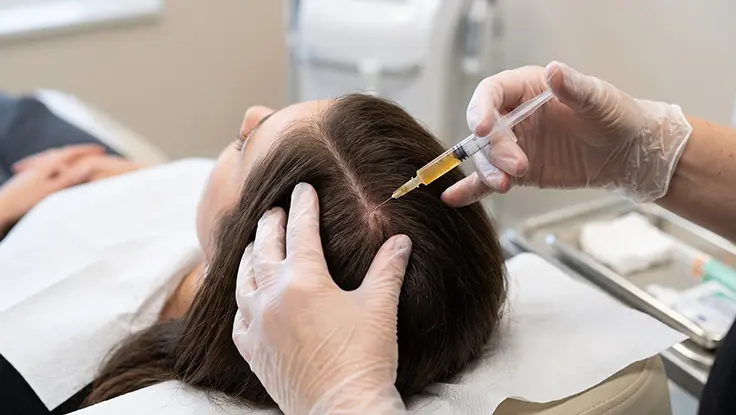
PRP and GFC are two treatments a dermatologist may consider. Both start with the patient’s own blood. They differ in how that blood is processed, what the final preparation contains and how growth factors reach the scalp. Knowing the difference makes it easier to choose with your doctor.
What Happens to Hair Follicles in Pattern Hair Loss?
Pattern hair loss, also called androgenetic alopecia, is a progressive condition that affects men and women. Genetics and sensitivity to a hormone called dihydrotestosterone (DHT) cause the affected follicles to shrink over time.
Smaller follicles produce shorter, thinner strands. Men most often lose hair at the temples and crown. Women usually notice thinning along the centre parting and the crown.
It looks different from person to person. Some people still have follicles that grow hair, only weaker. Others have lost much more, with advanced miniaturisation. The state of the remaining follicles helps decide which treatments may be suitable.
What Are PRP & GFC Hair Treatments?
PRP and GFC are both autologous, which means they are made from the patient’s own blood. Both aim to bring platelet derived growth factors to the scalp.
Platelet Rich Plasma (PRP): Concentrated platelets suspended in plasma. Platelets contain growth factors that act as signals for tissue repair and cell activity.
Growth Factor Concentrate (GFC): An autologous preparation made from growth factors released by activated platelets. Most of the cellular components are removed during processing.
Put simply, PRP carries platelets in plasma, while GFC mainly carries growth factors released during preparation.
How Are PRP & GFC Prepared Differently?
What ends up in the syringe depends on how the blood is prepared, so the two methods are worth looking at separately.
How PRP is prepared
- A small sample of blood is drawn from the patient.
- The blood goes into special collection tubes.
- The tubes are placed in a centrifuge, which spins them and separates the blood into layers by density.
- Depending on the protocol, one or two spins may be used to concentrate the platelets.
- The platelet rich layer is collected.
- The preparation is injected into the scalp.
- Once in the scalp, the platelets release their growth factors. Some protocols add an extra activation step, but it isn’t always needed for hair loss treatment.
How GFC is prepared
- A small sample of blood is drawn from the patient.
- The blood goes into specially designed tubes that encourage the platelets to release their growth factors. This is the activation step.
- The tubes go through a centrifuge, which separates the released growth factors from most of the blood cells and platelet material.
- The resulting fluid is collected.
- The fluid is injected into the scalp.
PRP vs GFC: What Are the Main Differences?
| Comparison factor | PRP | GFC |
|---|---|---|
| Preparation | Platelets are concentrated through one or two centrifugation cycles | Platelets are activated first, then growth factors are separated |
| Final composition | Platelets suspended in plasma | Growth factor rich fluid |
| Cellular components | May contain other blood cells | Designed to remove most cellular components |
| Growth factor release | Mainly after the platelets reach the scalp | During preparation |
| Treatment approach | Delivers concentrated platelets | Delivers growth factors that have already been released |
The two differ in how they are processed and in what the final preparation contains. Neither one guarantees a specific growth factor concentration or a particular regrowth result.
How Do PRP & GFC Support Hair Follicles?
Both treatments deliver growth factors that take part in cell signalling around the hair follicles. These proteins are involved in tissue repair, blood vessel formation and follicle development.
Some of the important growth factors include:
- PDGF (Platelet Derived Growth Factor): Involved in cell signalling and tissue repair, and linked to follicle development.
- VEGF (Vascular Endothelial Growth Factor): Supports the formation of blood vessels and blood supply to tissue.
- EGF (Epidermal Growth Factor): Involved in the growth and renewal of epithelial cells.
- IGF-1 (Insulin Like Growth Factor 1): Involved in cell growth and signalling linked to follicle activity.
These processes may support weakened follicles. Their presence doesn’t guarantee regrowth, though, and it doesn’t reverse the genetic and hormonal causes of pattern hair loss.
How Do Treatment Goals Differ Between PRP and GFC?
PRP may suit patients who want a platelet based treatment that has been studied in clinical settings for hair loss. It delivers concentrated platelets, which release growth factors once they are in the scalp.
GFC may appeal to patients who prefer a preparation with growth factors already released and less cellular material. Whether it suits you is a question for your dermatologist.
That doesn’t make GFC more effective. Comparative studies are still limited, and no evidence shows that one treatment beats the other in every case.
The stage of hair loss matters too:
- Early thinning: Existing follicles may keep growing hair, though the strands are thinner. Regenerative treatments can be one part of a wider management plan.
- Moderate thinning: A mix of approaches may be needed, depending on follicle health and the scalp assessment.
- Advanced hair loss: Injections alone may not be enough when follicles are badly miniaturised. Hair transplantation may be worth discussing, depending on the follicles available and the person’s suitability.
What Should Patients Expect During Treatment?
Both procedures involve blood collection, preparation and injections into selected areas of the scalp. The dermatologist plans the treatment based on the extent of hair loss, the condition of the hair follicles and your response to previous treatments.
Before starting treatment, patients should understand a few things:
- Sessions: Treatment usually involves several sessions spaced a few weeks apart. The number depends on the preparation method, extent of hair loss and individual response.
- Results: Changes in hair shedding, thickness and density take time to show. Progress is usually assessed over several months.
- Side effects: Temporary tenderness, redness, swelling or discomfort around the injection sites may occur.
- Maintenance: Additional sessions may be recommended based on treatment results and the progression of hair loss.
PRP and GFC do not replace hair loss medicines in every case. A dermatologist may also recommend Minoxidil or finasteride, depending on your condition and medical suitability.
Treatment costs depend on the preparation method, number of sessions and individual needs. In Coimbatore, PRP for hair loss typically falls within the usual Indian range of around ₹4,000 to ₹15,000 per session, while GFC usually costs more, often ₹5,000 to ₹12,000 or higher. Suitability and the overall treatment plan matter more than the price of a single session. Contact the clinic to know the actual cost based on your needs.
What Should You Consider Before Choosing PRP or GFC?
Start by finding out why the hair is thinning. Choosing a procedure just because it’s popular is the wrong way round.
A dermatologist may examine the scalp, review your medical history and assess hair density before recommending anything. Good questions to raise at the consultation:
- Is the hair loss caused by androgenetic alopecia or another condition?
- Which preparation system and protocol does the clinic use?
- Are my remaining follicles suitable for treatment?
- Would medication or hair transplantation be a better option?
- How will progress and maintenance be assessed?
Making an Informed Choice Between PRP & GFC for Hair Loss
PRP and GFC are two ways of getting platelet derived growth factors to the scalp. The better one depends on the extent of hair loss, the state of your follicles and what you need.
At Bonitaa Skin & Hair Care Clinic, you can explore hair restoration options such as PRP, GFC PRO, Exosome GFC, Biotin PRP and hair transplantation. If you’re weighing PRP for pattern hair loss against GFC for thinning, the dermatologist can explain how they differ and which one fits your scalp and the stage of your hair loss.
Every consultation starts with a scalp examination and a talk about what’s worrying you. Only then is a plan drawn up. Follow up visits show how your hair is responding and whether anything needs to change. With more than 15 years in skin and hair care, Bonitaa helps patients choose their hair restoration treatment with a clear idea of what to expect.
Frequently Asked Questions About PRP vs GFC for Hair Loss
Neither has been proven better for everyone. Both may help hair growth in people with pattern hair loss. After looking at your scalp and the follicles still active, a dermatologist can suggest the better fit.
You may not see a benefit if your follicles are severely miniaturised or have stopped producing hair. The dermatologist can let you know if injections, medication, or a transplant will be more effective.
This will differ depending on the technique, the degree of hair loss, and how your hair reacts. Most dermatologists will recommend you start with a few sessions first. Then, course follow ups are done and maintenance treatments are provided if necessary.
No. The genetic and hormonal causes of pattern hair loss stay in place with either treatment. You may need ongoing treatment and monitoring to keep it under control.
Occasionally. Your dermatologist may combine PRP or GFC with Minoxidil if it is appropriate for you, taking into account your condition, medical history and how you respond to treatment.
Both will include some type of injection into the scalp, so mild swelling or pain and tenderness are possible. Discomfort level varies from patient to patient and between protocols.